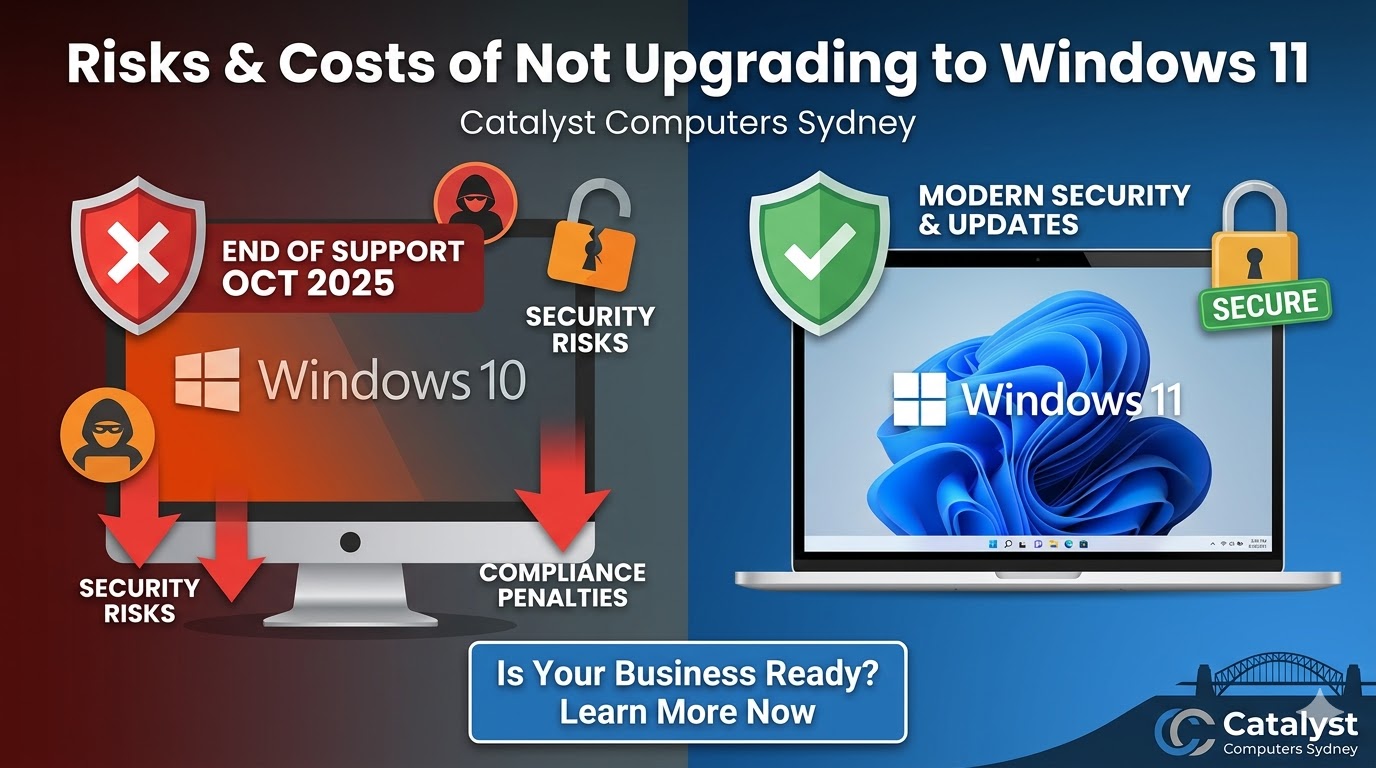
Still running Windows 10 across your business? You’re not alone. As of October 2025, approximately 36% of Windows PCs in Australia remain on Windows 10, and approximately four million commercial and education sector PCs across the country aren’t ready for the move to Windows 11 due to hardware limitations. But with Microsoft ending support on October 14, 2025, the clock is ticking and the risks are mounting.
At Catalyst Computers, we’ve seen firsthand what happens when businesses delay critical upgrades. The consequences extend far beyond a few missing features. Here’s what staying on Windows 10 will actually cost your business.
Security Vulnerabilities That Compound Daily
After October 2025, Windows 10 stops receiving security patches. Every new vulnerability discovered becomes a permanent weakness in your defences, and attackers know exactly where to look.
Your Systems Become Prime Targets
Cybercriminals specifically target organisations running unsupported software because they know these systems can’t be patched. In 2024, an average of 15 organisations per day became ransomware victims according to Cyberint’s Annual Ransomware Report, representing an 11% increase from 2023, with many targeting vulnerable systems lacking current updates.
The Breach Statistics Are Sobering
Organisations using outdated operating systems are three times more likely to suffer a data breach compared to those maintaining current systems. When breaches occur, the financial impact is severe. According to IBM’s Cost of a Data Breach Report 2024, data breaches cost Australian businesses an average of AUD $4.26 million per incident.
Financial Costs That Add Up Quickly
The true cost of not upgrading extends well beyond potential breaches. Multiple financial pressures converge to make staying on Windows 10 increasingly expensive.
Extended Security Updates Aren’t Cheap
Microsoft offers Extended Security Updates for organisations that can’t migrate by the deadline, but this safety net comes at a steep price. You’ll pay per-user, per-month premiums that escalate each year. These ongoing fees often exceed the cost of simply upgrading in the first place.
Cyber Insurance Complications
Cyber insurers assess your security posture before issuing policies. Running unsupported software significantly increases your risk profile, potentially leading to higher premiums or outright denial of coverage. Worse still, if you experience an incident while running unsupported systems, your insurer may refuse to pay your claim, leaving your business with unlimited liability.
Operational Inefficiencies
Outdated systems require more maintenance, experience more failures, and run slower than their modern counterparts. Your IT team spends more time troubleshooting problems instead of driving business value. Your employees waste time waiting for sluggish applications to respond.
Compliance and Legal Exposure
Running unsupported software creates serious compliance risks that extend beyond your IT department to your boardroom.
Australian Privacy Principles Require Current Systems
Australian businesses must comply with strict regulations including the Australian Privacy Principles, which mandate the use of secure and up-to-date technology to protect personal data. The Office of the Australian Information Commissioner increasingly demands rigorous data protection measures, and running unsupported software makes it difficult to demonstrate compliance.
Penalties for serious breaches of the Privacy Act can reach $50 million (or higher based on 30% of adjusted turnover formulas, whichever is greater), and regulators take a dim view of organisations that failed to maintain basic cybersecurity hygiene.
Director Liability Is Real
This isn’t just an IT problem. Company directors and business leaders can be held personally liable for security incidents. Using supported software is a critical step in demonstrating that leadership took reasonable precautions to protect the organisation.
Operational Risks That Disrupt Your Business
Beyond security and compliance, staying on Windows 10 creates practical operational challenges that worsen over time.
Software Compatibility Issues
Software vendors are increasingly optimising their products for Windows 11. As they shift focus, Windows 10 compatibility becomes an afterthought. Critical business applications may stop working properly or lose access to new features that your competitors are using.
Hardware Support Disappears
When your Windows 10 systems experience hardware failures, you’ll find vendor support increasingly difficult to obtain. Unexpected breakdowns become costly business interruptions with no clear path to resolution. Without access to computer repair support for legacy systems, downtime extends indefinitely.
You Fall Behind Competitors
While you’re managing legacy systems, your competitors are leveraging Windows 11’s AI capabilities, improved collaboration tools, and enhanced productivity features. The gap between your operational efficiency and theirs widens every month you delay.
Reputational Damage
Your technology choices affect how partners and clients perceive your business.
Partners and Clients Notice
Increasingly, businesses hesitate to work with organisations running outdated and potentially non-compliant systems. They worry about data shared between systems and the security implications of partnering with a company that hasn’t maintained basic security standards.
Trust Is Hard to Rebuild
If a security incident occurs because you were running unsupported software, explaining that to your clients will be difficult. The reputational damage from a preventable breach can take years to repair.
How Catalyst Computers Can Help
Planning and executing a Windows 11 upgrade takes time and expertise. At Catalyst Computers, we help Sydney businesses avoid these risks with a structured, stress-free migration process.
- We’re genuinely local. Our technicians live and work in Sydney. When you call, you speak to someone who understands Australian business requirements, not an offshore call centre.
- Fixed-price projects. You’ll know exactly what the upgrade costs before we start. No hourly billing surprises, no hidden fees.
- Zero-downtime upgrades. We schedule work outside business hours and provide immediate support if issues arise. Your team starts Monday morning on Windows 11 without missing a beat.
- 30-day support included. Every upgrade project includes 30 days of post-migration support at no extra cost.
- No contracts required. You pay for the upgrade project. That’s it. No monthly retainers or lock-in agreements.
Ready to Eliminate These Risks?
The October 2025 deadline is approaching fast. Every month you delay increases your exposure to security threats, compliance penalties, and operational disruptions. IT providers are booking up quickly, and hardware supply chains add additional lead time.
At Catalyst Computers, we’ll assess your current systems, identify migration requirements, and provide a fixed-price quote for your Windows 11 upgrade. No jargon, no pressure, just straight answers about protecting your business.
Contact Catalyst Computers today:
- Phone: 02 9160 0335
- Email: info@catalystcomputers.com.au
- Website: catalystcomputers.com.au
Book your free Windows 11 readiness assessment today. We’ll review your current setup, identify compatibility issues, and show you exactly how to upgrade before the deadline.
The cost of upgrading is predictable. The cost of not upgrading could be catastrophic.